What You Never Knew About SPAM
What You Never Knew About SPAMJimmy ChenThis is my submission for the “BlogBlog Party — July 2026”. This month’s theme is “interesting trivia or obscure concepts,” hosted by 劉昕. If you have your own blog, come join in!
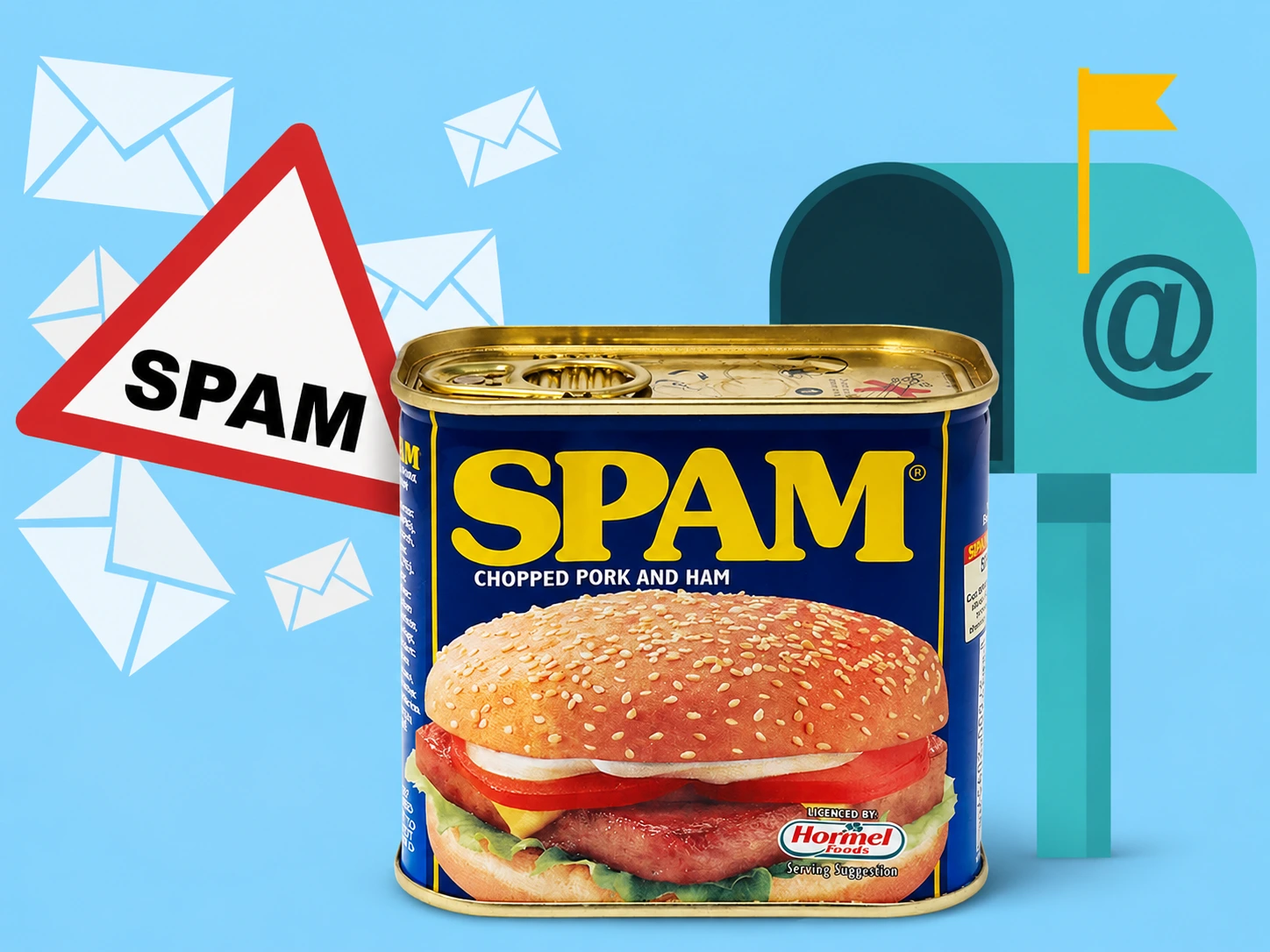
When you hear the word “SPAM,” does your mind jump to the tasty “luncheon meat”? Or to that damned “junk email”?
Let me tell you where the word SPAM came from!
Today’s SPAM luncheon meat is actually made of remarkably little: pork and ham, salt, water, potato starch, sugar, sodium nitrite — that’s it, nothing more. The original 1937 recipe didn’t even have the potato starch; that was only added in 2009, to reduce the layer of gelatin that forms after the meat is cooked inside the can. So unlike today’s ultra-processed foods, its ingredient list is comparatively simple. As for the pork, it’s mostly pork shoulder. Back in the 1930s, pork shoulder wasn’t a cut people considered good — it was harder to sell and worth less — and Jay Catherwood Hormel, spotting the opportunity, seasoned it and put it on the market.
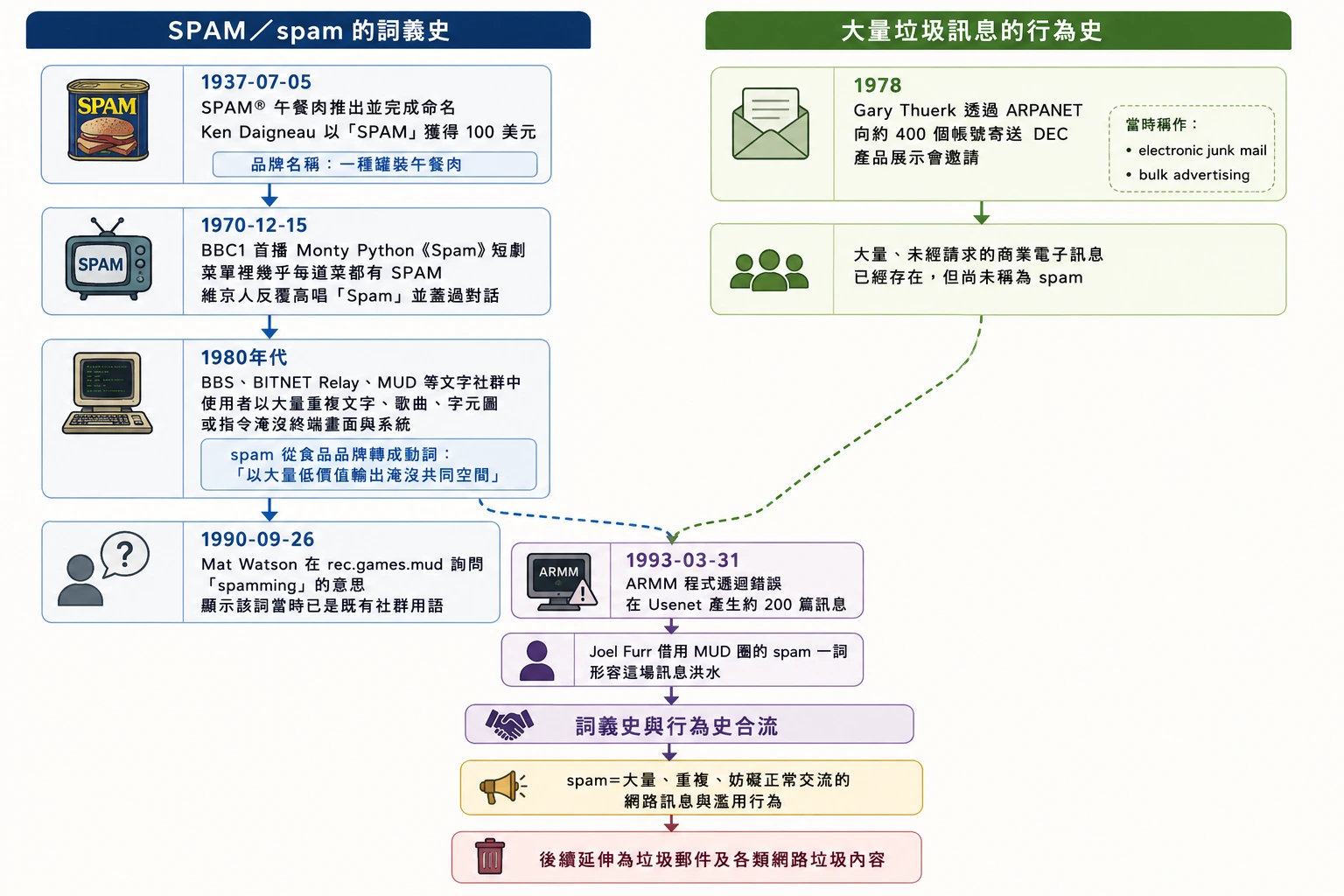
As for the name, it came out of a brand-naming contest Hormel Foods held on 5 July 1937. Ken Daigneau, the younger brother of one of Hormel’s vice presidents, won with the name “SPAM®” and took home a $100 prize.
But to this day nobody can fully confirm what SPAM is short for. The official FAQ only says that the true meaning of SPAM is known to just a small circle of former Hormel executives. So some people say it’s Shoulder of Pork and Ham, others say it’s simply Spiced Ham, and still others say it’s "Specially Processed American Meat" or "Specially Processed Army Meat". As for which is the truth — in the presence of delicious SPAM, maybe that isn’t all that important.
And why is it that Chinese calls this kind of food 「午餐肉」, literally “lunch meat”?
That comes from the English “Lunch Meat (Luncheon Meat),” originally a general term for processed meats that were pre-cooked and pressed into shape so they could be sliced and eaten cold or heated up, commonly used in sandwiches, cold platters, or quick meals. Americans at the time often put Lunch Meat in a sandwich for lunch, and that’s how the name came about. SPAM is one of the best-known brands of this kind of canned luncheon meat.
When SPAM launched in 1937, a 12-ounce can was advertised at roughly 28 to 35 cents, with 29 cents being one of the common prices. That works out to about 37 to 47 cents a pound, which wasn’t necessarily cheaper than every fresh meat of the day and was in fact higher than some fresh pork per pound. But SPAM was already cooked, boneless, and almost entirely edible, needed no refrigeration and kept for a long time, so when it came to reducing waste, simplifying cooking, and keeping supply stable, it had economic advantages that fresh meat didn’t always offer.
What really made SPAM spread fast was the large-scale military procurement and global shipping demand brought on by the Second World War. SPAM needed no refrigeration, was easy to crate and long-keeping, and could supply steady meat protein, which made it very well suited to being shipped overseas. Hormel’s official history records that more than 100 million pounds of SPAM luncheon meat were shipped abroad during the war to supply Allied troops. As the American and Allied supply networks expanded, SPAM also reached Britain, the Pacific islands, and much of Asia, gradually becoming a wartime food with global recognition.
Up to this point, SPAM is still nothing but a canned luncheon meat brand. So why do we now use it to stand for “junk email”?
For that we have to start with British wartime and postwar food memories, and with one absurd comedy sketch from 1970.
After the Second World War broke out, Britain was heavily dependent on overseas imports and its shipping was under threat from the war, so food rationing was introduced in 1940. Meat, bacon, ham, butter, sugar, and other basic foods were all restricted; and after the war ended, shortages and rationing continued for years, with meat rationing not fully lifted until 1954. In that environment, canned meats like SPAM — needing no refrigeration, easy to store and transport — naturally had practical value. It also arrived in Britain in quantity along with Allied supplies, becoming a conspicuous food in wartime and postwar eating. That said, rather than calling SPAM a “cheap meat substitute” that every British household depended on, it’s more accurate to say it became a vivid cultural symbol of wartime canned food, rationed living, and monotonous menus.
On 15 December 1970, BBC1 in Britain first aired episode 12 of the second series of Monty Python’s Flying Circus, whose “Spam” sketch pushed the impression of SPAM luncheon meat being “everywhere” to an absurd extreme: nearly every dish on the little café’s menu contains SPAM, and the Vikings in the corner keep chanting “Spam, Spam, Spam” — the word SPAM comes up well over a hundred times!
Inspired by the “Spam” sketch, on the live-scrolling text terminals that appeared in the 1980s — BBSes, BITNET Relay, and MUDs — some users started typing “spam” over and over, or dumping the whole Spam Song, text files, and ASCII art into chat rooms so that normal conversation scrolled off the screen. This prank gradually came to be called spamming, and the earliest record of it is from 26 September 1990, when Mat Watson asked on rec.games.mud about it: he saw spamming all the time but didn’t know exactly what it meant, and guessed it might have to do with entering large numbers of commands, causing server problems, or crashing things.
Then on 31 March 1993, Richard Depew was testing a Usenet auto-moderation program called ARMM (Automated Retroactive Minimal Moderation). Because of a recursion bug, it posted around 200 messages in a row to a Usenet group, each subject line gaining another “ARMM:”, with the headers and Message-IDs growing longer and longer — reportedly even breaking at least one mail system. Group member Joel Furr borrowed the word “spam,” already popular in the MUD community, to describe this flood of messages. That incident brought the SPAM usage into Usenet, and through the large-scale online advertising incidents that followed it gradually became the general term for junk messages.
Of course this wasn’t the first junk message in history. The real first junk email ever sent was on 1 May 1978, when Gary Thuerk, a marketer at DEC (Digital Equipment Corporation), used the ARPANET directory to send about 400 accounts an invitation to a product demonstration for the DECSYSTEM-20 (a mainframe computer). This is widely regarded as the earliest fully documented case of bulk commercial junk email. It quickly drew protests from recipients and from ARPANET’s administrators, because it consumed public research network resources, violated the acceptable use rules, and gave companies with network access an unfair commercial advantage. At this point, though, the word SPAM hadn’t been attached to any of it yet — people were still using the conventional terms “electronic junk mail” and “bulk advertising.”
Through the word SPAM, we can see how words keep evolving in the great current of history, as if they were alive and endlessly reproducing, turning into shared memory across several generations. It’s as though our own memory is being SPAMMED over and over — and by the look of it, it will keep SPAMMING for a good while yet!
Discussion and responses
Reply on the Fediverse or Bluesky. Public responses received through Webmention appear here.Fediverse entryBluesky
Your browser connects to GitHub and Giscus only after you open this tab. A GitHub account is required and comments are public.